Problem
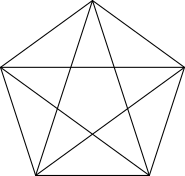
Count the number of distinct triangles formed when a regular pentagram is drawn inside a regular pentagon by connecting every second vertex (i.e., draw the five-pointed star formed by skipping one vertex each time).
The figure consists of a regular pentagon with its five vertices connected every second vertex, producing the familiar five-pointed star (pentagram) whose intersecting diagonals create five interior intersection points.
Strategy
Outline of the counting method:
- Classify triangles by the types of their vertices: whether a vertex lies on the outer pentagon (“perimeter vertex”) or at an intersection point formed by the pentagram (“internal point”).
- Use the \(5\)-fold rotational symmetry to count representatives of each class and multiply appropriately; verify there is no double counting.
- Where necessary, examine local configurations around one vertex/edge and propagate by symmetry.
Solution
We proceed by enumerating triangle types.
Type I: three perimeter vertices. Choose any \(3\) of the \(5\) outer vertices. This gives
\[\binom{5}{3} = 10\]
triangles.
Type II: two perimeter vertices and one internal intersection. Consider an outer edge as a potential base. For each outer edge there are a fixed finite number of internal intersection points that together with that base produce triangles contained in the figure. A local inspection (or symmetry argument) shows there are \(3\) distinct interior-point choices per edge that yield distinct internal triangles, and counting over the \(5\) edges gives
\[5 \times 3 = 15\]
triangles of this type.
Type III: one perimeter vertex and two internal intersections. Around each outer vertex, the two nearby intersection points formed by the star lines create exactly one triangle together with that vertex (by symmetry and direct inspection). Hence there are
\[5\]
triangles of this type.
Type IV: three internal intersection points. Some triangles are formed solely by three intersection points of the star’s diagonals. By symmetry and explicit counting of admissible intersection-triples one finds
\[5\]
such triangles.
Summing the above counts yields the total number of distinct triangles formed:
\[10 + 15 + 5 + 5 = 35.\]
Conclusion
By classifying triangles according to vertex types and exploiting the pentagon’s symmetry, one deduces that the pentagon with its inscribed pentagram contains exactly \(35\) distinct triangles.